


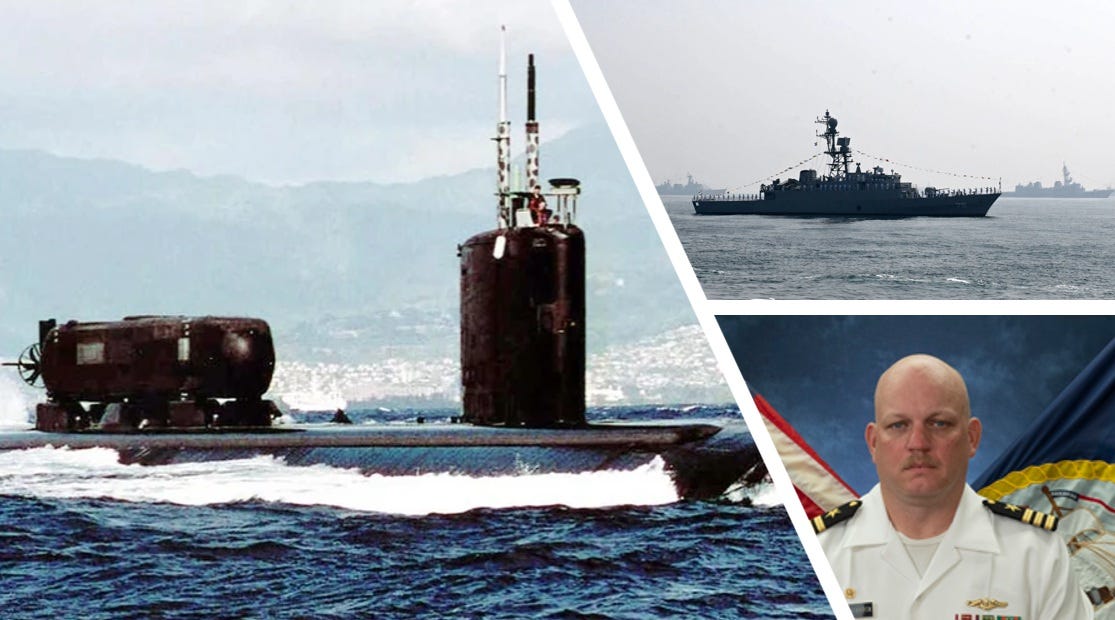
USS Charlotte (with Special Operations deployment vessel), IRIS Dena, and Charlotte C.O Commander Thomas Futch.
The March 4 sinking of the Iranian frigate IRIS Dena 40 miles off the coast of Sri Lanka by the U.S. nuclear submarine USS Charlotte rivals the May 2, 1982 sinking of the Argentine cruiser ARA General Belgrano by the British nuclear submarine HMS Conqueror outside the Falkland Islands Total Exclusion Zone (TEZ) as one of the more treacherous attacks by a submarine since the end of World War II. Some 323 Argentinian crewmen died in the sinking, with many survivors perishing in lifeboats in cold stormy seas without being rescued by UK Royal Navy assets in the area.
In the Indian Ocean and without warning, the Charlotte (SSN-766), a Los Angeles-class attack submarine, launched two MK-48 heavyweight torpedoes that sank the 180-crew and passenger Dena. The Iranian frigate had previously departed the Indian naval port of Visakhapatnam where it participated in the biennial International Fleet Review 2026 and MILAN 2026 naval exercise sponsored by the Indian Navy. The attack killed at least 87, with 61 remaining missing. Some reports stated that 87 bodies had been recovered by rescuers.
In response to a distress signal from the Dena, located 40 miles off Galle in southern Sri Lanka, the Sri Lankan Navy and Coast Guard, as well as the Indian hydrographic survey ship INS Ikshak, the three-masted barque training vessel INS Tarangini, and Indian maritime patrol aircraft were deployed for search and rescue operations that rescued some 32 crewmen of the Dena. Sri Lanka and India demonstrated a commitment to international law of the sea that was ignored by the Charlotte, a black mark that will forever haunt the U.S. Navy.
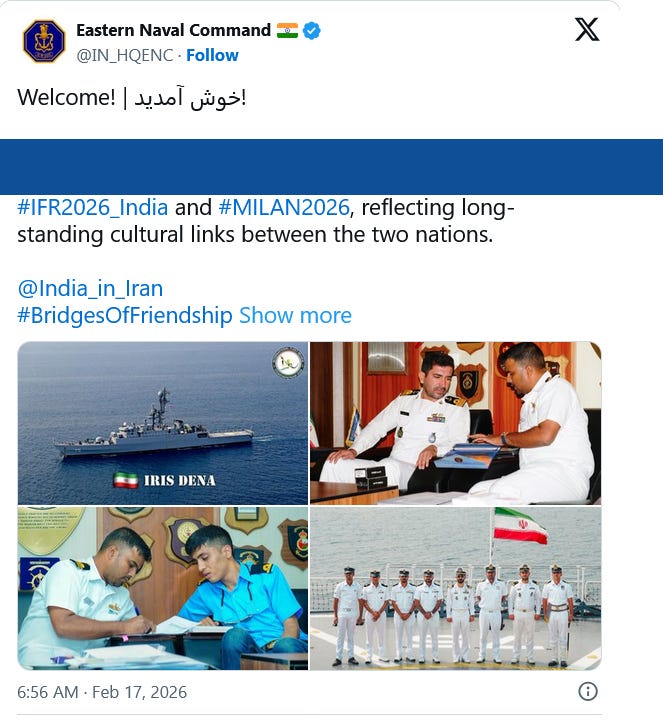
The U.S. Navy had participated in the same Indian-hosted 74 nation naval regatta and exercise, which saw a U.S. Navy P-8A maritime patrol aircraft flying drills alongside the Dena mere days before the Charlotte sank the ship. The Dena was reportedly unarmed at the time, which is not unusual for a participant in an international naval review. This fact would have been known to the Pentagon and the U.S. Navy. MILAN 2026 also involved the USS Pinckney (DDG-91), an Arleigh Burke-class Aegis guided missile destroyer.
Article 18 of the Second Geneva Convention of 1949 requires belligerents to take all possible measures to search for and rescue survivors of sunk vessels during armed conflicts. The convention was written in the aftermath of World War II to address the heinous acts carried out by the German and Japanese navies in the murdering survivors of naval, merchant, and passenger ships on the high seas. The Charlotte’s attack on the Dena was the first reported U.S. submarine torpedo kill of a ship since World War II.
Two other Iranian Navy ships in Sri Lankan waters, the 208-crew IRIS Bushehr, a naval auxiliary supply vessel, and the IRIS Lavan, both of which participated in MILAN 2026, sought and received protection from Sri Lanka and India, respectively. They both reported mechanical failure as a reason for requesting asylum.
The Bushehr, which had also participated in MILAN 2026, anchored just outside of Sri Lankan territorial waters shortly after the U.S. attack on the Dena. All but 15 Iranian crewmen, who remained on the ship as caretakers, were transferred to the Welisara Naval Base near the Sri Lankan capital of Colombo. Sri Lankan President Anura Kumara Dissanayake said the decision by Sri Lanka was meant to uphold the country’s neutrality and its commitment to humanitarian law. In a shocking revelation, the president and other Sri Lankan officials suggested that the Bushehr was not berthed at the strategic maritime port of Colombo because it might have faced a military attack by a belligerent power. There was little question that the reference was to the United States. Instead, the Bushehr was berthed at the Sri Lankan naval base at Trincomalee. The port of Colombo is Sri Lanka's largest and most crucial seaport, serving as a major South Asian maritime, shipping, and transshipment hub between Europe and the Far East.
Former Sri Lankan foreign minister H.M.G.S. Palihakkara stated, “There has been a distress call from the ship. So naturally Sri Lanka, as a party to the Law of Sea and The Hague Convention, had no option but to do what it did by mounting a humanitarian operation to provide assistance to save lives and provide medical care to the affected.”
IRIS Lavan, a landing ship, requested and received permission to dock at the Indian naval base of Kochi. The ship’s 183-member crew were housed in Indian naval barracks.
Clearly, Charlotte’s Commanding Officer, Commander Thomas Futch, and his senior officers failed to send out a call for assistance to ships and other parties in the area capable of rescuing survivors. Three members of the Royal Australian Navy were also aboard the Charlotte at the time of the torpedoing of the Dena. The Charlotte faced no hostile forces in the area so there was no reason for it to break radio silence to send out a Mayday alert on all emergency frequencies. This constituted a dereliction of lawful obligations under international humanitarian law, law of armed conflict, and the U.S. Department of Defense Law of War Manual, notwithstanding the maverick leadership of “War Secretary” Pete Hegseth and Commander-in-Chief Donald Trump.
Making matters worse, the U.S. Navy displayed extra-legal procedures on a vessel on the high seas that was not lost on the other participant navies in MILAN 2026. They included naval units from India, Australia, Japan, France, Germany, Indonesia, Thailand, Philippines, Vietnam, Bangladesh, Malaysia, Maldives, Mauritius, Myanmar, Oman, Seychelles, Sri Lanka, South Korea, United Arab Emirates, Iraq, Yemen, Russia, South Africa, Canada, Italy, Spain, and Brazil.
The USS Charlotte brought nothing but shame on the U.S. Navy and the United States.